

This story is about Terra, the Earth, and her best friend Laura, the Sun. Terra is ill and allows Laura to examine her as at the doctor’s. Her blanket is getting thicker and thicker. She is warming up. There are too many sunrays that can’t escape and stick to her skin. Terra used to be happy. But now she is ill because of many dirty clouds that stick to her blanket. Laura says she can heal with the help of people who guarantee there are fewer dirty clouds. That is a breath of fresh air for Terra!
Theme: global warming, climate change.
This is a “coat rack story”. You can hang other KaMOShibai stories on it. They further develop what you can see in Laura's magnifying glasses.
Subthemes:
- Heat, being ill and being examined
- Friendship and taking care of your friend
- The earth, the sun, the clouds and the blanket (atmosphere)
- Dirty clouds (exhaust fumes)
- The children talk about being ill and being healthy
- It is a very hot day / week.
- Before, during or after a heat wave, also felt at school.
- The school is organising a climate project which you want to participate in with your class group.
- You want to participate in the Day or Week of the Earth (April 22 ff.) with some of your colleagues.
- Some children have joined a climate march or bring a picture of it.
Science and Technology
• Nature: General skills: 1.2 The pre-schoolers demonstrate an exploratory and experimental approach to learn more about nature.
• Nature: General skills: 1.3 With the help of an adult, the pre-schoolers can use simple resources to learn more about nature.
• Nature: General skills: 1.8 the pre-schoolers can observe, compare and name different weather conditions and give examples of the consequences for themselves.
• Nature: Health: 1.9 The pre-schoolers can identify the difference between being ill, healthy and injured in themselves and in others.
• Nature: Health: 1.10 the pre-schoolers can in concrete situations recognise behaviours that are beneficial or harmful to their health.
• Nature: Environment: 1.13 the pre-schoolers show an attitude of care and respect for nature.
• Technology: Technology as a human activity: 2.3 the pre-schoolers can in a simple situation verify which technical system best meets a need.
• Technology: Technology as a human activity: 2.9 The pre-schoolers show an experimental and exploratory approach in order to learn more about technology.
• Technology: Technology and society: 2.10 the pre-schoolers can indicate that a technical system they use can be useful, dangerous and / or harmful.
Knowledge of the world area, Man and Society
• Human: Me and myself: 1.1 The pre-schoolers can recognise in themselves when they are afraid, happy, angry or sad and can express this in a simple way.
• Human: Me and myself: 1.3 The pre-schoolers show sufficient self-confidence in their own abilities in concrete situations.
• Human: Me and the other: 1.5 The pre-schoolers can recognize in others feelings such as being afraid, happy, angry and sad and can empathize with these feelings.
• Human: Me and the other: 1.7 The pre-schoolers can show sensitivity to the needs of others.
• Human: Me and the others in group: 1.8 The pre-schoolers can stand up for themselves by giving signals that are comprehensible and acceptable to others.
• Human: Me and the others in group: 1.9 the pre-schoolers know and understand manners, precepts and agreements that are important for living together in a group.
• Human: Me and the others in group: 1.10 the pre-schoolers can make arrangements in concrete situations with the help of an adult.
Musical education
• Musical education - Drama: 3.1 The pre-schoolers can articulate their own adventures, experiences, thoughts, feelings, actions.
• Musical education - Drama: 3.2 the pre-schoolers can empathize with different characters and things from their environment and portray them.
• Musical education - Media: 5.1 the pre-schoolers can cope with audio-visual messages intended for them.
• Music education - Media: 5.3 the pre-schoolers can determine, change, arrange, rearrange the sequence of a series of objects, pictures, images, tones and sounds and tell a new story about it.
Maths initiation
• Maths initiation numbers: 1.1 The pre-schoolers can actively and verbally compare one concrete number of things with another number of things. In articulating they use the appropriate quantity concepts. (as many / not as many things, many / few things, too many / too few things, things about / things too short, more / less things, most / least things).
• Maths initiation measuring: 2.3 The pre-schoolers can rank things according to the increasing or decreasing degree of a particular qualitative characteristic.

|
Feel: empathize |
|

|
Think: observe and explore: |
Distinguish between: |

|
Do: work in an organised and active way with the children |
• In response to Laura’s request, propose actions to help Terra. • Willing to sustain a chosen action for less dirty clouds. • Invite others to take action together. • Invite others to take more action.
|

|
4.7 By 2030, guarantee that all learners acquire the knowledge and skills needed to promote sustainable development |

|
12.8 By 2030, guarantee that people everywhere… are aware of sustainable development and lifestyles in harmony with nature |

|
13.3 Improve education, awareness-raising and human and institutional capacity on climate change mitigation, adaptation, impact reduction and early warning |
|
Prent 0 – titel + cover 
|
|
|
Picture 1: Terra + thermometer 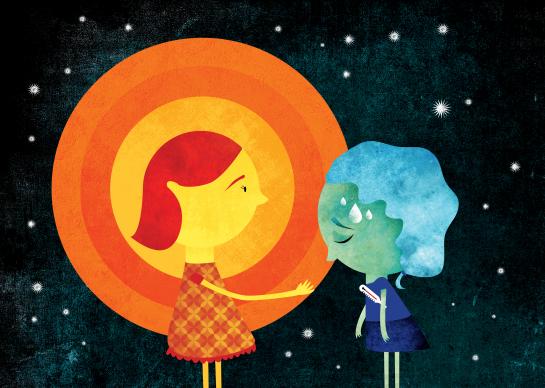
|
|
|
Picture 2: Terra was happy 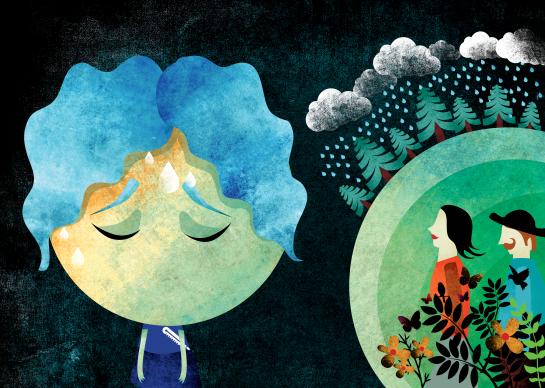
|
Possible key questions that go with this picture
|
|
Picture 3: Black smoke 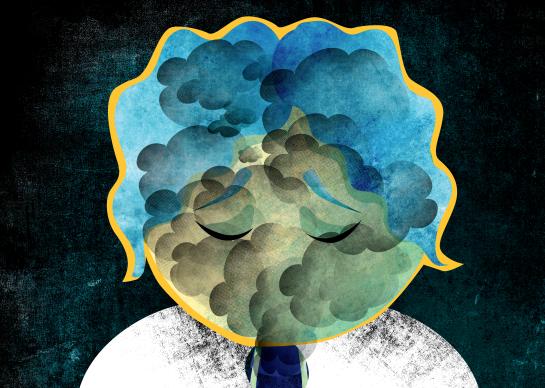
|
Possible key questions that go with this picture |
|
Picture 4: Laura with stethoscope
|
Possible activities that go with this picture |
|
Picture 5: factories and construction 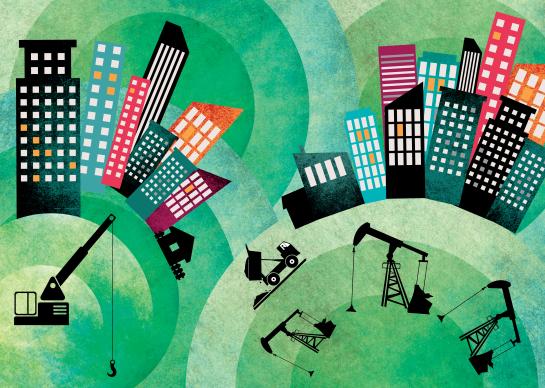
|
|
|
Picture 6: magnifying glass / dirty clouds 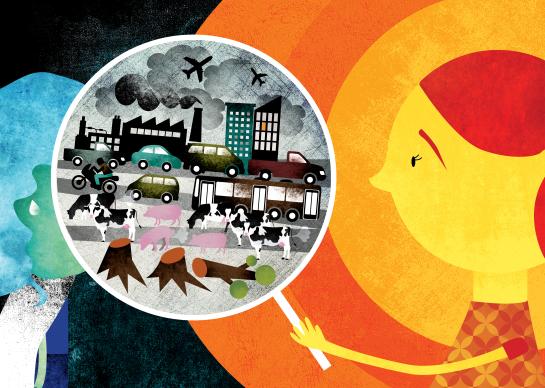
|
Possible key questions that go with this picture |
|
Picture 7: Terra is warming up
|
Possible key question that goes with this picture |
|
Picture 8: magnifying glass and stethoscope – iceberg is melting 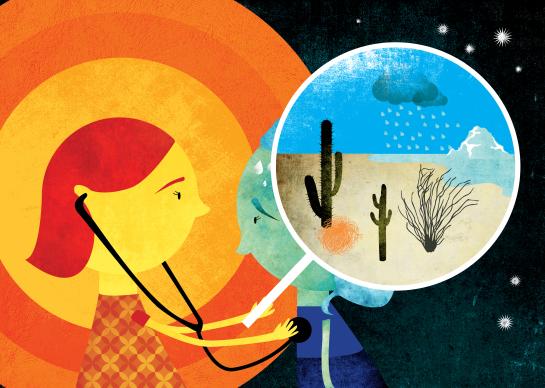
|
|
|
Picture 9: magnifying glass – Terra is feeling better 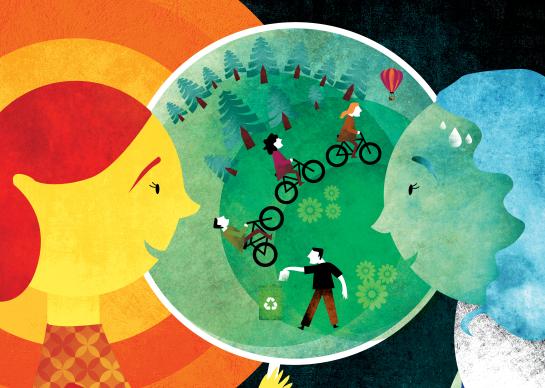
|
|
|
Picture 10: Laura: are you willing to help Terra? 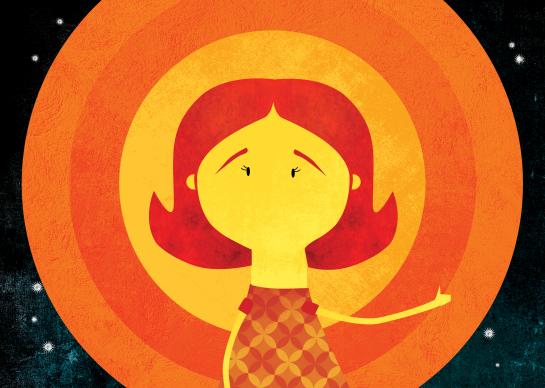
|
Possible key questions that go with this picture Tips for possible activities |
The characters’ feelings
• Picture 1: Terra is not feeling well, Laura is worried / curious.
• Picture 2: Terra was happy.
• Picture 5: Laura is surprised.
• Picture 9: Terra is happy, enthusiastic, relieved.
Research tools
• Thermometer: picture 1.
• Stethoscope: picture 4 and 8.
• Magnifying glass: picture 6, 8 and 9.
Search well
• Detailed observation:
o Picture 1, 3, 4, 8, 10: Why are there (so many) white stars?
o Picture 2: What makes Terra happy in this picture? What do you see in the people on this picture? How many birds, butterflies and flowers do you see? Are these dirty clouds?
o Picture 5: Are any people living here or are they all factories? What makes you see that? Do you see windows with the lights on? How many cranes / how many trucks can you count? Do you know what those cranes get out of the ground / earth? What is that truck doing?
o Picture 6: What can you see through Laura's magnifying glass? Are these dirty or beautiful clouds? Who makes these clouds? Is it just cars? Is it just cows that fart?
o Picture 8: What do you see through the magnifying glass?
o Picture 9: And what do you see through this magnifying glass? How can you see Laura and Terra like this?
• Comparative observation
o What differences do you notice between Terra and Laura in pictures 1, 2, 9 and 10?
o What differences do you notice in Terra in picture 3 and picture 9?
o When the story is well known: what differences do you notice in Terra in pictures 2, 3 and 7?
o Comparing picture 6 and 9: what do you see in the magnifying glass?
Important comment: in picture 9 you see a symbol for recycling. The picture suggests that recycling can also contribute to reducing global warming (on condition it is not about "dirty clouds" coming from waste incineration). This could put you on the wrong track. Recycling is important because it saves raw materials. Yes, but there are actions that contribute a lot more to the climate. For example: using less fossil fuels by limiting car and air miles, insulate your house so that you need less heating, eat less meat,…
Real or not real
• Can we see or feel the earth? Can the earth wail / cry?
• Can we see or feel the sun?
• Can the sun examine the earth? Can the earth and the sun talk to each other?
Generally
Active / again / questionable / to mean / to build / I think that’s a difficult one / lately / (more) odd / enthusiastic / to itch on the go / not calm down for a second / no wonder / rumbling and stumbling / to gush /
to have a good time / in all the colours of the rainbow / whopper / to stick / to mumble / uncountable / invisible / surplus / suddenly / to prick / weird / to fly past her nose / rain / since then / to look blue /
towing and lugging / to conjure up magically / all kinds of things / skin / to stick oneself on / to scare oneself to death / to defend oneself / like / to sigh.
Being ill and getting better
Worried / that takes a long recovery / something is wrong / flu / to cough / I to feel a little better / I don't feel good about myself / to wail / you are still a long way off / fever / to itch / body / seriously ill / what's the matter with me / sweat.
To research
This requires further research / concentrated / thinking out loud / knowing the details / to discover / to explore / stethoscope / thermometer / to study closely / magnifying glass.
Global warming
Petroleum / to refuse all waste / to cut down and burn forests / blanket (little) / factories / the ice is melting / are on fire / you warm up / masses of cows / to take the car no longer / to fart and burp / coal / to take action / two hundred years ago / to emit / dirty clouds / volcanic eruption / sunbeam (little) / black smoke.
To reconstruct together the story of Terra's being ill and getting well again
Exchanging experiences and feelings about being too hot and sick
Exchanging experiences and feelings about friendship and introducing a friend booklet
Ideas for a musical approach and processing when empathizing
Participation by the children / participation by others
To reconstruct together the story of Terra’s being ill and getting well again.
With this story, you should quickly give the children the opportunity to retell it. In this way you can see more quickly whether they have got a big enough piece of the pie. You get a lot of tips to retell the story yourself. In pairs, the children can repeatedly do a part of the dialogue between both characters. Pair 2 continues where pair 1 ends. The pictures can be shown and / or hung up in sequence.
You can also deepen the story together with the children on the basis of 3 essential questions. These questions are also discussed in "being too hot" and "being sick" (see below):
• What is going on? What does Terra feel?
- It seems as if her skin is on fire. She sweats a lot…
- She’s got black smoke on her stomach. Dirty clouds stick to her blanket. Her blanket is getting thicker and thicker. She warms up.
- In certain places it is getting very dry. In other places the ice is melting ...
• How come? Where do those many dirty clouds come from?
- The people take coal and petroleum from underneath her skin
- They build factories to make all kinds of things
- They drive cars, trucks, motorcycles, buses… emitting dirty smoke
- They travel by airplanes
- They cut down the woods or they burn them down.
• How does Terra get better? How will fewer dirty clouds be produced? How can her blanket recover?
- When people go on foot or by bicycle and not by car.
- When people eat less meat.
- If people refuse waste they get in the shops, e.g. single-used plastic.
Exchanging experiences and feelings about being too hot and sick
| Being too hot / heat | Being ill and getting better again |
| Game activity to start with or as a “snack” in between: experiencing sweating during movement commands by wearing too many clothes or putting on a cap, carrying a backpack... This could become a small investigation. | |
|
When are you hot, too hot? |
Who has already been ill? What was going on? How did you get better again then? |
|
What is going on?
Also nature, trees, plants and flowers, animals feel it and are thirsty. |
What is going on (symptoms)?
|
|
How come?
|
How come? (examination and diagnosis)
|
|
How do you get better?
|
How do you get better? (remedy)
|
Exchanging experiences and feelings about friendship and introducing a friend booklet.
- Have a circle time about being friends: what do you do together. How do you take care of each other? When can you call your relationship friendship? What do you do when your friend or girlfriend is ill. Is friendship different for boys and girls?
- You can design and distribute a friendship bracelet with Terra pictured on it.
- Create a custom friend booklet from Terra.
- Look for characteristics of Terra together with the children
- Each child gets a copy. Stimulate them to illustrate the booklet..
- The children receive help in completing their own page.
- They can also position themselves on Terra: where am living on Terra? What actions do I take to help Terra.
- Fill in the characteristics of friend Laura together with the children
- Let the children take their friend booklet with them and ask some friends to add something.
Some ideas
| I am … | Terra the Earth | Laura the Sun |
| I draw myself; this is a picture of myself | ||
| I am … | 4 billion years | 5 billion years |
| I am living in … | space | space |
| I’m good at … | turning, taking care of people and nature | shining, providing heat and light, taking care of day and night |
| I’m happy when … | children go on foot, ride by bike, turn off the lights | I see children playing |
| what makes me sick, is | dirty clouds, a lot of airplanes, waste | quarrel … |
| I can laugh with … | a cow that farts and burbs | a cow that farts and burbs |
| I am sad … | when people only think of themselves | when Terra is ill |
| My favourite colour is | blue like water and green like nature | yellow, orange, gold |
| I like listening to … | music from space | music from space |
|
I love |
my blanket, trees and woods, beautiful flowers, birds and all the animals that are living on me … | sunflowers … |
| I can … | be very nice | be very sunny |
| My best friend is | Laura the Sun | Terra the Earth |
| I am helping Terra by … | ... | ... |
Ideas for a musical approach and processing when empathizing.
- Tinker a Terra doll and give it a place in the circle. The children can ask questions and make suggestions. Use the doll to respond to situations, also during the current school year.
- Let the children retell the story with objects (thermometer, stethoscope, magnifying glass, care products …).
- Play "true or false games" related to friendship, heat, illness, the story of Terra and Laura.
- Take pictures of situations. Have children portray situations that can be photographed: what do you do together as friends? What do you do when it is too hot? What do you do when you are sick and want to get better? Have the children act out the friendship between Terra and Laura and let them examine and care for Terra. Provide a toy thermometer, stethoscope, magnifying glass, dress-up clothes, first-aid kit, parasol, fan, in a bed: a globe with a blanket, or in a wheelchair, etc. Take nice pictures and enjoy viewing the results together.
- Free play with a range of dress-up clothes and objects. The children play Terra and Laura. Green and blue for Terra. Yellow and orange for Laura. Add a blanket, "dirty clouds" and examine tools.
- Paint / draw / tinker things connected to the story:
- Draw or paint freely connected to the story.
- Terra is ill / sad and Terra is healed / happy.
- paint a large circle on paper with white, blue and green colours.
After being dried, apply the blanket e.g. with cotton wool. Possibly, distinguish between white, grey and dirty clouds / black smoke.
- Collage: tear pieces of coloured paper from magazines (tearing technique) and put together a collage about Terra and Laura: light to dark yellow for the sun, light to dark blue and green for the earth, light to dark grey for the dirty clouds and black for space.
- Suggestions for moments of movement or activities:
- Experiencing and investigating sweating during play with much or less clothes on.
- Playing a tapping game: if you have been touched by a black cloud, you can no longer participate
- Active sorting with walking orders: what is good for Terra and what would she rather not have?
- Children's yoga: salute to the sun
- Breathing and relaxation exercises.
Participation by the children / participation by others
- The children determine together which aspects of the story they want to elaborate on.
- They choose to empathize with either Terra or Laura.
- They may make proposals: who would they like to invite into the classroom or what would they like to visit.
- Consider whether you can invite a carer, (male) nurse, doctor, arborist, energy saver into the classroom.
For those who want even more
- You can clarify sayings connected to the sun: melt like snow in the sun, after the rain the sun will reappear, put someone in the focus of attention, to be a little ray of sunshine in the house / in the classroom, shine like the sun.
- For your information: fever is not a disease in itself. Your body heats up to defend itself against unwanted invaders (viruses, bacteria, ...). It is a signal to slow down a bit, to let your nature’s resilience do its work,… It may be interesting to compare it with Terra’s fever or "disease".
