

The world is facing a gigantic amount of waste. Some of it was used only once or hardly at all (e.g. a tin can). Moreover, a significant proportion of the waste ends up in nature (plastic soup, litter, dumping) Not exactly a pretty picture, right?
In Flanders, we are sorting champions. That is a good thing. But collecting and processing our waste also costs energy and causes extra air pollution. Moreover, much of that waste can be avoided. So there has to be another way. Together we are going for less waste! Are you in?
The pupils examine what waste is, how waste streams are created, how society deals with it, and how we can avoid waste as much as possible. The following non-limitative questionnaire can help in setting up the research.
Waste that belongs in nature/the forest
We observe the verge under a tree.
- What happens to the leaves and twigs on the ground?
- Who helps to remove the leaves, fallen twigs and branches?
- And what happens to dead animals in the forest/nature?
- How long does it take for leaves, twigs and animals to be cleared by nature?
- Is there a difference in time there? Why is that?
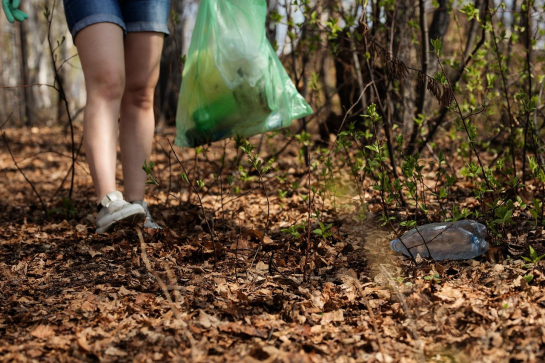
Waste that does not belong in nature/the forest
- What have you found? What material is it made of (plastic, metal, paper, glass, ...)?
- How did it get here? What do you think about that?
- Who produces these materials? Where do the raw materials come from?
- How come it does not decompose or get eaten?
- Can we find out how long it takes before it is gone?
- And is it really gone then? Or not? → e.g. microplastics
- What can you conclude about organic versus non-organic waste?
Me and my waste (toys, wardrobe, food, ...)
- How do I/do we handle waste at home?
- Do we (properly) sort our caste at home? Do we compost it? How do we do this?
- Do we try to avoid waste at home? Why do we do this?
- How do we try to minimise our waste?
- Do I avoid waste at home? How so? Can I do better? How?
Waste at school
- What types of waste do we have at school?
- How does it end up at school? (Who brings it?)
- What do pupils bring with them (and what do they leave behind)? What comes from the school itself?
- How is the waste collected?
- Is it sorted or not? Why (not)? Is it done properly?
- Where does the school's waste go? What happens to it?
- Can we try to reduce the amount of waste at school?
- What is the best way to do this?
The school launches a challenge for the school team, the pupils, the (grand)parents and external partners of the school (e.g. suppliers) to help limit the waste streams at and to the school to a minimum. Together, we look for creative solutions to give seemingly redundant or outdated materials a new and meaningful life (e.g. pimping).
Below is an example of a possible action. Of course, you are free to come up with your own actions, but always keep in mind the goal (less waste).
Action 1
Each class identifies its waste streams for a certain period of time (e.g. a week). This can be done using photos, drawings, graphs, etc. (depending on the age). Both teachers and pupils participate. Every day, the waste that was or still is being brought in is discussed (briefly), whether it can be avoided, and what the zero-waste alternative is. Based on this, the teacher and pupils take action at class level to bring as little waste to school as possible.
Action 2
The results from the different classes are presented and discussed at the student council, the MOS council or another student forum. It is examined where the school itself can still make an effort (e.g. less use of paper) and whether (and how) this is feasible. The proposals are put on a to-do list and handed over by the pupils to the school principal with much fanfare.
Action 3
Take the pupils to the attic, cellar or other cluttered places. You will certainly find things there that can get a second life. Give the class a search assignment (e.g. Pinterest) to find creative, fun ideas to repair or pimp forgotten items. Can't they be put to good use or find a place at school? Then organise an auction (e.g. during the school’s open house), either for the school's own benefit (e.g. to finance the landscaping of the playground) or for a good cause favoured by the school.
Golden tip!
Giving things away feels great! Why not install a share and/or give-away cupboard at school?
- A clear "Yes!" from the entire school team is one of the keys to success. Take the time to discuss the project with them. If desired, let the MOS-team coach you.
- At policy level, it is important to get the purchasing department and the coordinating board on board. Some schools are tied to contracts, meaning that things cannot proceed immediately in the short term. Check with the suppliers how and where deliveries can be more waste-friendly.
- (Grand) parents play an essential role in making a successful low-waste school. It is best not to take any action without first discussing the intention with them. Keep in mind that it will also require effort from them. Give them a say, but keep monitoring the targets set and dare to motivate them.
- Look for Jacks-of-all-trades in and outside of school. Do not forget the school handyman/woman. They are invaluable, for example, in helping to repair or pimp old objects (see action 3).
- Regularly discuss the waste project at the pupil or MOS council. Signal problems when things threaten to go wrong somewhere.
- Get inspired by innovating examples such as the zero-waste shops, thrift stores, pick-your-own farms, etc.
- Ask the municipal environmental service how they can support you.
- Involve (grand)parents from the very beginning of the project. Let them have a say.
- Visualise the progress in a fun and visual way. Let the pupils think this through and work it out. Make parents and visitors aware and inform them (or have the pupils inform them).
- Share the initiative through all social media channels known and used by the school.
- Invite dignitaries and the media. Use this opportunity to explain (with the pupils) how you approached it and what the criteria were.
- Testify at forums and meetings with other schools about your approach. Exchange experiences. Learn from each other.
- Are the school buildings used by third parties after hours? If so, at least inform them of your goals and actions. If necessary, talk to them and make clear agreements.
We give you an idea of how long it takes before certain products that we regularly find by the side of the road, are broken down by nature. Don't be surprised!
- Paper and cardboard - 6 months
- Cigarette butts - 2 to 12 years
- Chewing gum - 20 to 25 years
- A tin can - at least 50 years
- A bottle of glass - 1 million years
- A PET bottle - does not degrade → becomes microplastics
- A plastic bag - does not degrade → becomes microplastic
Giving old items a new purpose is wonderful and satisfying. However, make sure that it also gets a sustainable character, so the item can live on for a couple more years. Nothing worse than it ending up in the trash after a few days or weeks. That way, a well-meant action eventually becomes a waste of your trouble. And that would be a shame, wouldn't it?
- www.mosvlaanderen.be/kamoshibaiverhalen: MOS developed kaMOShibai stories especially for toddlers and younger children. “Zack’s journey”, “Red, the lunch box”, “Ant has a problem” and “Dylan shares” link up with the theme of waste.
- Kostbare Kost: Want to know everything about food waste? Then the MOS teaching materials ‘Kostbare Kost’ are definitely for you!
- www.bewustverbruiken.be/artikel/de-piraminder: The “pyraminder” gives a clear and simple view on how we can consume less. Also perfect to use with children!
- www.ikdeel.be: Website about sharing initiatives for schools. With a roadmap, teaching materials, and good practices.
- www.dekringwinkel.be: Website of the well-known Kringwinkel shops, with fun ideas for reusing (and therefore less waste).
- www.cleanuptheworld.org: International website about the action ‘Clean up the World’.
- www.plasticsoupfoundation.org: Everything you need to know about plastic soup can be found on this website.
- www.meiplasticvrij.com: Action-oriented website by and for schools. To turn ‘mei-plasticvrij’ (May Plastic-Free) into a success at your school as well. Just do it!
- Scholenwerking IVAREM – IVAREM: On this website of IVAREM you can find a lot of tips to make your school low-waste. There is also an offer for preschools and primary schools with possibilities to follow workshops in the area of IVAREM.
- Wat doet IDM voor scholen? | IDM: IDM makes many efforts to help schools create as little waste as possible within the school walls. It provides educational and logistical support and helps schools to develop projects on the theme of waste.
Did you know that ... in 2018, 3.1 million tons of household waste was collected in Flanders? That is 468 kg/resident. (Source: www.ovam.be)
The annual MOS action day #MissionLess brings awareness of consumption.
Conscious consumption = less waste!