

Dylan is new at school. He hasn’t made any friends yet. Bilal has got a second-hand bicycle. But he has a problem. Dylan knows someone who can help! His mom works in a bicycle repair shop. The whole class may visit the shop. They get a bicycle for school. Especially Sophie is happy with it. Because she has wanted a bicycle for so long. There is no room for a bicycle at her house.
Theme: sharing, reusing (= second-hand)
Sub-themes: being different, cycling
- There is someone new in the class. Children react to someone's appearance.
- The school organizes a theme day on reuse. There is a second-hand fair at the school or in the area.
- An incident related to cycling has happened at the school or on the playground.
- You work out the theme 'bicycle' in class. There is a cycling day at school.
- You work out the theme 'Professions' or 'Mother's Day': being proud of your mom!
Man and Society
- Man: Me and the other: 1.4 in concrete situations the pre-schoolers can recognize different ways of interacting with each other and talk about it.
- Man: me and the other: 1.5 the pre-schoolers can recognize in other’s feelings such as being afraid, happy, angry and sad and can empathize with these feelings.
- Man: me and the other: 1.6 The pre-schoolers know that people can experience the same situation in various ways and react to it differently.
- Man: me and the other: 1.7 pre-schoolers can show sensitivity to the needs of others
- Society: Socio-economic Phenomena: 2.1 the pre-schoolers can describe in a simple way adults’ occupations and activities they know.
- Society: Socio-economic phenomena: 2.2 in a concrete situation, the pre-school children can make a distinction between giving, receiving, exchanging, borrowing, buying and selling.
- Society: Socio-cultural phenomena: 2.3 the pre-schoolers can recognize different family forms.
- Society: Socio-cultural phenomena: 2.4 the pre-schoolers recognize forms of rejecting or appreciative responses to the differentness of people.
Sciences and Technology
- Technology: Core components of technology: 2.1 the pre-schoolers can specify from technical systems they often use themselves, whether they are made of metal, stone, wood, glass, paper, textile or plastic.
- Technology: Core components of technology: 2.2 the pre-schoolers can demonstrate from a simple technical system in their environment that different parts of it are related to each other in function of a predetermined goal.
- Technology: Technology and society: 2.10 the pre-schoolers can indicate that a technical system they use can be useful, dangerous and / or harmful.
Mathematical Initiation
- .Mathematical Initiation - Measuring: 2.1 Pre-schoolers can, acting and verbalizing, compare two things on their qualitative characteristics.
- Maths Initiation> Measuring: 2.2 The pre-schoolers can compare things qualitatively and bring them together based on one or two common characteristics.

|
Feel: empathize |
|

|
Think: observe and explore |
|

|
Do: work in an organized and active way with the children |
|

|
4.7 By 2030, ensure that all learners acquire the knowledge and skills needed to promote sustainable development. |

|
12.8 By 2030, ensure that people everywhere have the relevant information and awareness for sustainable development and lifestyles in harmony with nature. |
|
Title + cover 
|
|
|
Picture 1 - Sophie thinks Dylan is weird 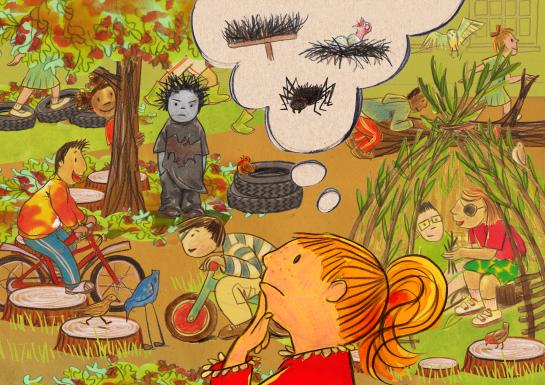
|
Possibly key questions:
|
|
Picture 2 - Dylan feels alone 
|
Possibly key questions:
|
|
Picture 3 - Bilal and his bicycle 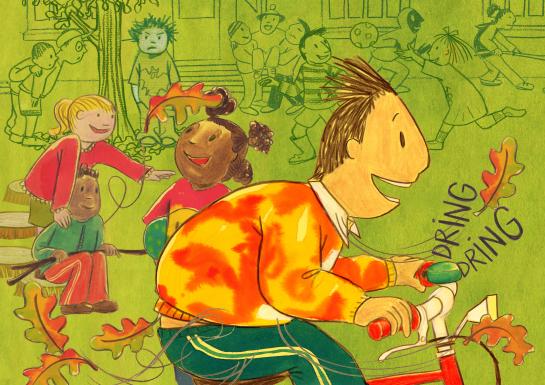
|
Possibly key questions:
|
|
Picture 4 - Bilal’s bicycle stalls (stops working) 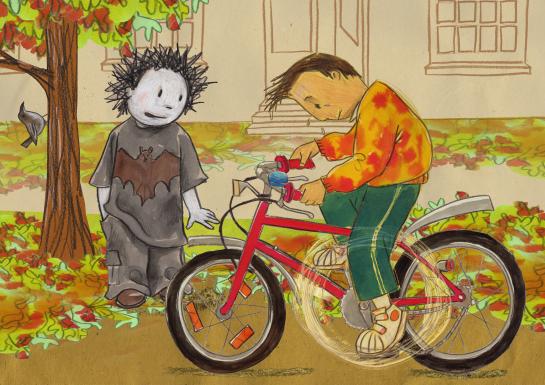
|
Possibly key questions:
|
|
Picture 5 - Can I help you? 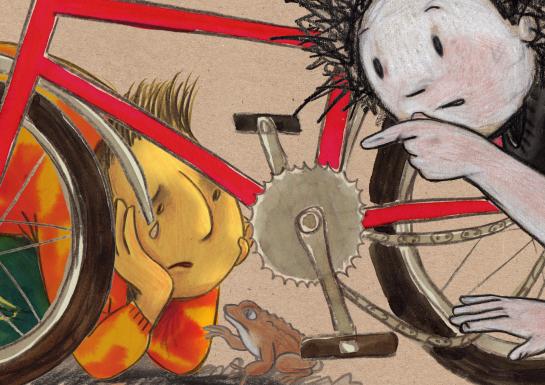
|
|
|
Picture 6 - Dylan’s Mom helps 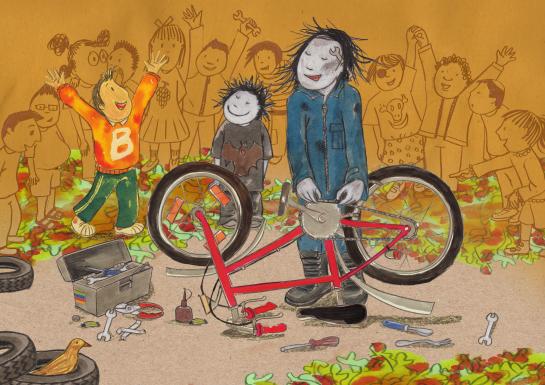
|
Possibly key questions:
|
|
Picture 7 - as cackling chickens 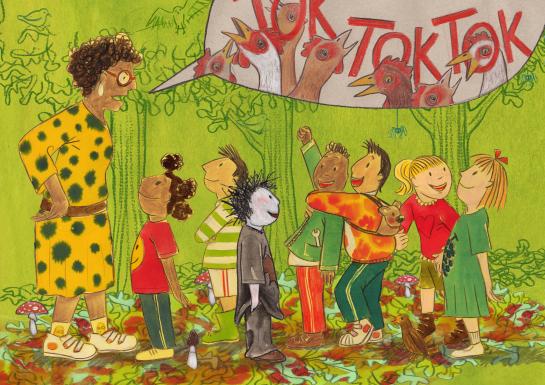
|
|
|
Picture 8 - Welcome to the bicycle repair shop 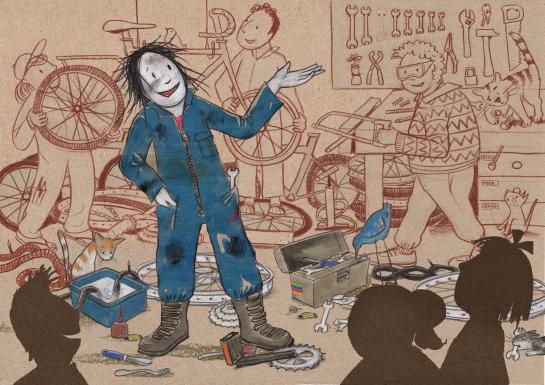
|
Possibly key questions:
|
|
Picture 9 - Surprise for the class 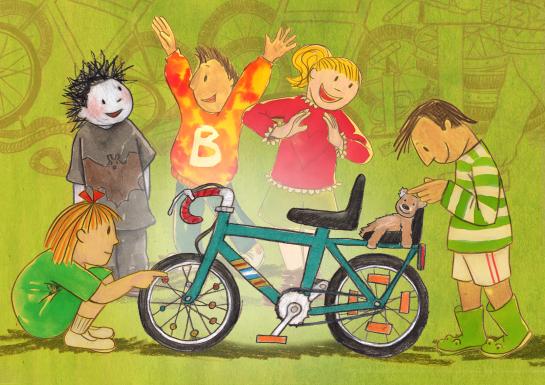
|
|
|
Picture 10 - Sophie is extremely happy 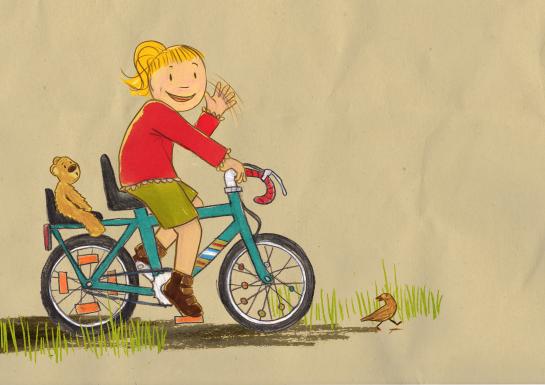
|
|
|
Picture 11 - A kiss for Dylan 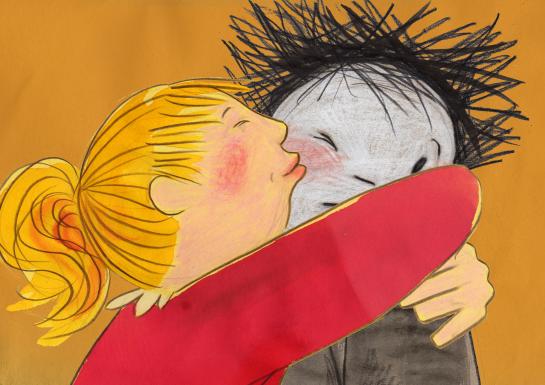
|
Possibly key questions:
GOLDEN TIP
|
Characters of the story
- Dylan: picture 1, 2, 3, 4, 5, 6, 7, 9, 11.
- Sophie: picture 1, 3, 7, 9, 10, 11.
- Bilal: picture 1, 3, 4, 5, 6, 7, 9.
- Dylan's Mom: picture 6, 8.
- Teacher: picture 7.
- Classmates: picture 1, 3, 6, 7, 9.
Characters’ feelings
- Picture 2: Dylan feels alone. He hates the city and the school. Feeling angry.
- Picture 3: Bilal likes cycling.
- Picture 6: the children are astonished. Dylan is proud of his mom. Bilal is happy.
- Picture 7: the children are noisy, nervous.
- Picture 8: the children are astonished. Sophie is jealous.
- Picture 10: Sophie is extremely happy.
Observe in detail
- Picture 1: what can you say about Dylan’s and all the other children’s appearance? What does Sophie think when she sees Dylan's appearance? What are the children doing in the playground? What do you notice about the playground? How many birds can you count?
- Picture 2: what do you see? What animals do you see? What is Dylan doing? What's on the floor? What season could it be?
- Picture 3: what are the children doing? What colour is Bilal's bicycle bell?
- Picture 4: Describe Bilal's bicycle.
- Picture 5: What are Bilal and Dylan watching? What animal do you see?
- Picture 6: what similarities do you see between Dylan and his mother? What letter is on Bilal's sweater? What tools does mom have? What has mom got behind her ear? What is mom doing? What do you notice about the children in the background?
- Picture 7: what do you notice about the teacher and the children’s appearance? What animals do you see? Why are there chickens?
- Picture 8: what do you notice about mom's appearance? what do you see in a bicycle repair shop? How many animals do you see?
- Picture 9 and 10: describe the bicycle the class will receive.
Comparative observation
- Compare Dylan's facial expressions in the different pictures.
- Compare Bilal's bicycle (picture 4) and the bicycle the class gets (picture 9).
- Can you find the children of picture 7 in picture 1?
General
Be going on / prove / broom / flashy / bang! bash! / the hero of the day / a bunch of cackling chickens / handy / hate / Bilal is closer to crying than to laughing / diligent / I don't like Dylan / after all / tingling in the belly / lunch break / quiet / spiky hair / edge / noisy / exciting / move.
Sustainable
Waste / recycling shop / second-hand / wasting.
Bike
As if I'm losing the pedals / bike repair shop / mending / chain / oil stains / cycling in turns / repair / wrench and screwdriver / lubricate / gear wheel / work clothes.
Exchanging experiences and feelings related to cycling
Exchanging experiences and feelings related to excluding
Telling the story with the kamishibai box on the bike
Encourage children’s participation
Exchanging experiences and feelings related to cycling
- Do you have a bicycle? Type? Who has been given, borrowed, … a bicycle?
- What kind of bike would you like to have? Have you ever been jealous, happy,… with a bicycle?
- Who polishes or decorates your bicycle? Nice, not nice?
- Who can cycle? Who wants to learn it? Are you sometimes afraid or are you insecure when you’re cycling? Can/will you still persevere, keep cycling and overcome your fear?
- Has your bike ever been broken? What happened in order to fix the bike? Who did that?
- Have you ever fallen with your bicycle? Or have you ever collided? Have you hit someone or something? What did you feel then?
- Can you also be happy with a second-hand bicycle? Does it always have to be new? Do you also like things that have already been used?
Exchanging experiences and feelings related to excluding and including in the group
- Finding someone weird, his/her looks, clothes, being different, ...
- Standing on the edge, not being allowed to play, excluding someone.
- Being angry, hating, being friend and not being friend any longer, feeling alone.
- Playing together, sharing together, taking turns, making arrangements.
- Being proud of your mom, dad...
- Kissing, hugging.
- Liking or disliking.
Reconstruction of the story
Divide the roles and let the children empathize with the characters’ feelings:
Dylan who feels alone and somewhat excluded, finds himself on the edge.
- The classmates who play and exclude Dylan.
- Bilal who is happy with the second-hand bicycle he got from the family.
- Bilal has a problem with his bike and Dylan wants to help him.
- The teacher calls Dylan's mom who comes to solve Bilal's problem.
- The classmates as cackling chickens who visit a bicycle repair shop (bicycle corner).
- The children receive a second-hand bicycle. They admire it.
- Sophie is allowed to drive it and gives Dylan a kiss. The classmates include Dylan in the group.
Telling the story with the kamishibai box on the bike
- Initially, some Japanese storytellers mounted their storytelling box on their bicycles. They drove from village to village. They also sold sweets. Whoever bought sweets was allowed to sit in the front to listen.
- You can build in and convert this as follows: mount your storytelling box on a second-hand bicycle (see ABC-house Brussels). Show up with your bike. Don't hand out unhealthy candy, but something healthy you can share together before or after the story.
Encourage children’s participation
- Let the children choose their own role when retelling the story.
- Make an inventory together with the children of situations and tools they can share. Have them act out this and take pictures of the event.
- Let the children visually process the story, the experiences and feelings: my bicycle, we share a bicycle, …. the bicycle I dream of, … a print of a bicycle tire, … painting, drawing or crafting with wire, cardboard, paper, …
Observing and investigating bicycles
Clarify and apply yourself concepts and situations related to reuse
Promoting children's participation
Observing and investigating bicycles
- Discover different types of bicycles and their function. Do comparative research of these types of bicycles:
- Balance bike: learn to keep balance when moving forward
- Cargo bike or bicycle with extra luggage carrier: extra space to transport something or someone.
- Tandem: riding in pairs or more.
- Electric bicycle: extra support.
- Speed pedelec high speed (= very fast: dangerous or not?)
- second-hand or new: reuse.
- 2-wheeler, 3-wheeler, 4-wheeler: help with balance.
- Folding bike: easy to take with you in train or car
- Rickshaw: transport of 1 or 2 people (see increasing number of senior rickshaws).
- Discover characteristics and parts of the (children's) bicycle: bell, pedals, chain, sprocket, wheels, spokes, tires, lights, frame, brake pads, brakes, handlebars, gears, saddle,…
- How does a bicycle work? Take a look at a children's bicycle: the wheels can turn. In order to move forward you have to run or push pedals with your feet. You have children's bicycles:
- without pedals (balance bikes).
- With pedals but without chain.
- With pedals, chain and sprocket.
- Discover tools for easy and safe cycling: bicycle helmet, bicycle pump, bicycle bag, bicycle trailer, raincoat, extra light, yellow jacket, reflective material, child seat for the back or front of the bicycle, windshield, bicycle flag,…
- Compare bicycles in brochures, also compare prices of new and second-hand bicycles.
- Have bicycles maintained, decorated, polished, stowed/parked.
- Get acquainted with 'crazy bicycles' (see De Lustige Velodroom in Blankenberge) and, if feasible, a bicycle that has been put together from other bicycles (see story).
Inquiry related to cycling and reuse
Formulate research questions and hypotheses together with the children. Search answers together:
- How to cycle? Who can cycle (safely)? Who can demonstrate how to cycle properly? What should you pay attention to? Who can cycle a track on the playground?
- Does a second-hand bike ride as well as a new bike?
- Who comes to school by bike? Who rides with you?
- Where can you find a traffic sign in connection with cycling in the vicinity of the school and what does it mean?
- What is the best way to park a bicycle?
- Is the school and the surrounding area friendly to bicycles? What can be improved?
Clarify and apply yourself concepts and situations related to reuse.
- What is second-hand? (Re)use an already used bicycle. What else can you reuse? (see also second-hand toys, clothes, …). What can we use a second time in our class instead of getting rid of it?
- What is the difference between reuse, share, exchange and give, get, borrow, buy and sell? Let the children practise this thoroughly, for example in the class shop.
- Visit a recycling shop and/or a second-hand shop: who has already been there? What can you find there? What is the purpose? Why do they say "recycling shop"? Does this store work like a regular store? What will we buy for the classroom?
Promoting children's participation
- Start from the children's own bicycles and cycling experiences at home and in the school.
- Let the children decide what types of bicycles they want to learn about more.
- Let the children formulate their own research questions in connection with cycling and reuse.
- Also discuss children's experiences and feelings regarding tools for easy and safe cycling.
For those who want more
- Get to know Piraminder from the Conscious Consumption Network. When purchasing, keep this order in mind: first use what you have / share or exchange / go for second-hand (reuse) / make it yourself / buy only what you really need.
- See possible elaboration for the oldest pre-schoolers in the VIVES thesis by Margot Denys and Sophie Catteeuw (2018) Sustainable living. How can we make the concept of the 'Piraminder' live in kindergarten? https://www.Scriptiebank.be/sites/default/files/thesis/2018-09/Bachelor…
- Compile a photo book about cycling in the past and elsewhere in other countries. Put it in the theme corner or in the book corner.
Organize cycling campaigns with parents and others
Promoting participation by children
Organize a show moment
- Have the children act out the story and let them show the story box on the bicycle.
- Show what the children have discovered about cycling.
- Let the children explain why and how they share, play together, …
- Let the children give their opinion about the advantages and disadvantages of reuse.
- Call on parents and/or other classes to organize a bicycle campaign, or an activity or project together, either in connection with cycling (see bicycle campaigns) or related to reuse.
Organize cycling campaigns with parents and others
- Provide polishing, pimping and repair days for bicycles.
- Teach children how to ride a bicycle safely and smoothly. Organize a bicycle track, bicycle traffic park, the tour of ... .
- Make children's bicycles available at school. Develop this as a project, together with interested parents: prepare, implement and follow up.
- Organize a second-hand market at school with bicycles and cycling tools.
- Have a bicycle shed built/improved at school or in the school’s vicinity with the cooperation of parents or the municipality.
- Collaborate with the school on an initiative to share children's bicycles in the municipality. See for example www.opwielekes.be.
- Encourage children to come to school by bicycle. https://www.mobiel21.be/campaigns-en-projecten/sos-mijn-kind-op-de-fiet…. See also 'Master on the bike - Cycling skills training in your school'.
- Draft a letter to improve the cycling situation at the school. Let children and other people support the call by signing it. Reinforce this appeal with a bicycle bell concert.
- Work together with the parents' association, the municipality, bicycle initiatives in the neighbourhood, ….
- Publish positive testimonials from parents and children, e.g. in the school newspaper, on the website, on Facebook, etc. to encourage others to participate.
Promoting participation by children and parents
- Let the children decide what they want to bring at the show moment.
- Make your choice, together with the children, to emphasize reuse (second-hand) or bicycles.
- Decide together with the children which actions are preferred.
For those who want more
- Contribute to the sustainable school policy. Frame the bicycle campaigns and also the campaigns related to cycling, sharing and reusing in your school's policies and calendar.
- Be inspired by other sharing initiatives for the school. See http://www.ikdeel.be/
- Set up actions related to sharing, exchanging and giving away in collaboration with the primary school, parents and the neighbourhood: cleaning and repairing toys, lending or handing out toys and picture books,…