

Bee lives in a wooden closet on farmer Jeff's apple farm. She is living there with her sisters, brothers and the Queen. They are processing nectar from the flowers into honey and pollinate the flowers so that apples can grow on the trees. Bee has worked hard in the hive and is now flying out. She is introduced to Lony who is living alone in an old dead tree. Together they visit each other's house. They have become friends and fly to the village together. In one garden you can find more delicious things than in the other. They meet Bumblebee who lives in a mouse hole. Bumblebee can growl loudly. Bumblebee flies on. They meet Wasp. He lives in a house with chewed bark from trees. Bee, Lony and Bumblebee fly further past a hive with dead bees. Only one bee remains and it can fly with the others to Bee's house. Night falls.
Theme: bees, small animals with wings, how insects live and work
Sub-themes: blossom, bee and her family, the solitary bee, the wasp, the humblebee, nectar and honey
- You want to draw attention to “bee’s” week (May 30th – June 6th)
- You work out the theme 'Spring – The Orchard'.
- You are looking for a story about 'The flowers and the bees'.
- You want to involve the children in greening the school.
- An insect hotel has been placed or you want to hang one.
Man and society
- Man: me and myself: 1.1 the pre-schoolers can recognize in themselves when they are afraid, happy, angry or sad and can express this in a simple way.
- Man: me and the other: 1.5 the pre-schoolers can recognize in other’s feelings such as being afraid, happy, angry and sad and can empathize with these feelings.
- Man: me and the other: 1.6 The pre-schoolers know that people can experience the same situation in various ways and react to it differently.
- Man: me and the other: 1.7 pre-schoolers can show sensitivity to the needs of others
Musical education
- Drama: 3.2 the pre-schoolers can empathize with different characters and things from their environment and portray them.
Languages
- Language Listening: 1.3 the pre-schoolers can understand an oral message intended for them, supported by image and/or sound.
- Language listening: 1.6 The pre-schoolers can demonstrate willingness to listen to each other and to empathize with a message.
- Language speaking: 2.1 the pre-schoolers can formulate or reformulate a message intended for them and/or a story intended for them in such a way that its content is recognizable
- Language speaking: 2.3 the pre-schoolers can talk about feelings such as happiness, fear, sadness, wonder
- Language speaking: 2.10 The pre-schoolers can empathize with clearly recognizable roles and situations and respond to them from their own imagination / experience
Science and technology
- Nature: General skills: 1.2 The pre-schoolers show an exploratory and experimental approach to learn more about nature.
- Nature: Environment: 1.13 The pre-schoolers show an attitude of care and respect for nature.

|
Feel: empathize |
|

|
Think: observe and explore |
|

|
Do: work in an organized and active way with the children |
|

|
4.7 'By 2030, ensure that all learners acquire the knowledge and skills needed to promote sustainable development.' |

|
12.8 'By 2030, ensure that people everywhere have the relevant information and awareness for sustainable development and lifestyles in harmony with nature.' |

|
15.5 'Take urgent and significant action to reduce the degradation of natural habitats, halt the loss of biodiversity and, by 2020, protect and prevent the extinction of threatened species.' |
|
Picture – title + cover 
|
|
|
Picture 1 - Bee is flying out for the first time 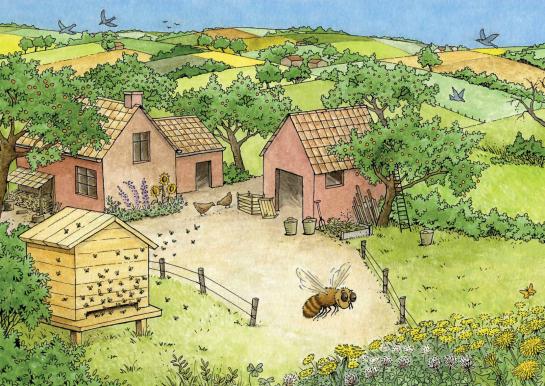
|
|
|
Picture 2 - My name is Lony 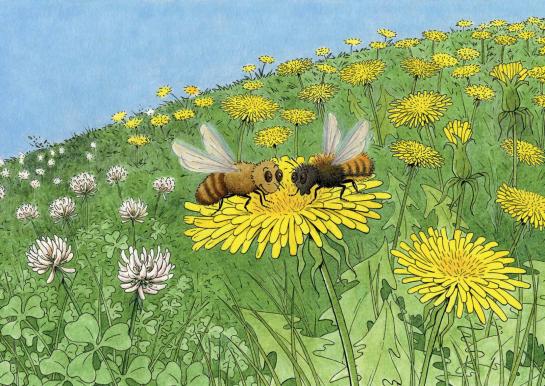
|
|
|
Picture 3 - Where are you living? 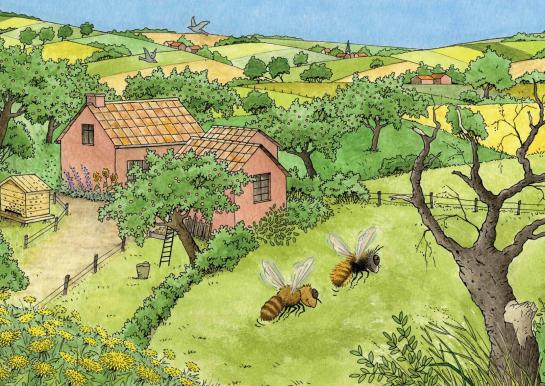
|
|
|
Picture 4 - Lony does it alone 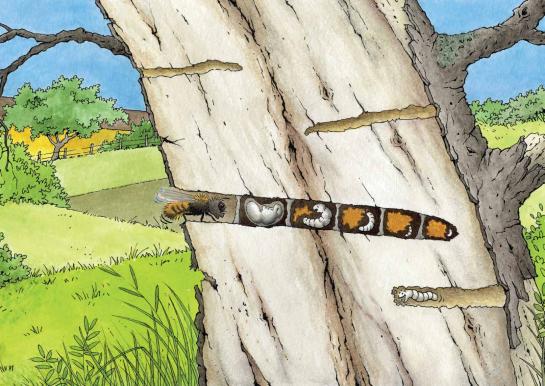
|
|
|
Picture 5 - What a bustle in Bee’s house. 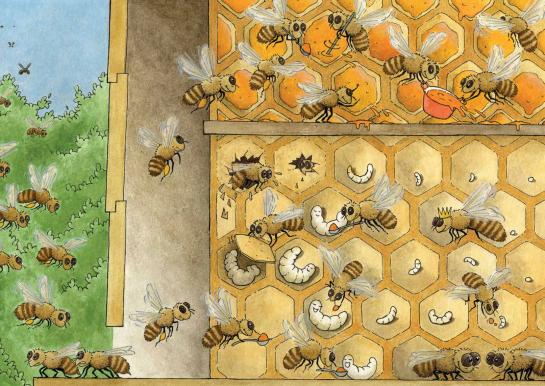
|
Honeybees (facts)
There are three kinds of bees in a honey colony: the queen, the worker bees and the drones. The queen lays about 2000 eggs per day. In addition to nectar, bees also collect pollen which serves as food that is rich in nutrients. They collect this pollen in small clogs on their legs. |
|
Picture 6 - Food is getting scarce 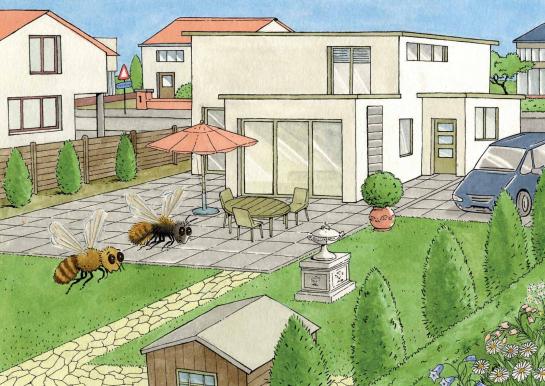
|
|
|
Picture 7 - A garden with delicious things 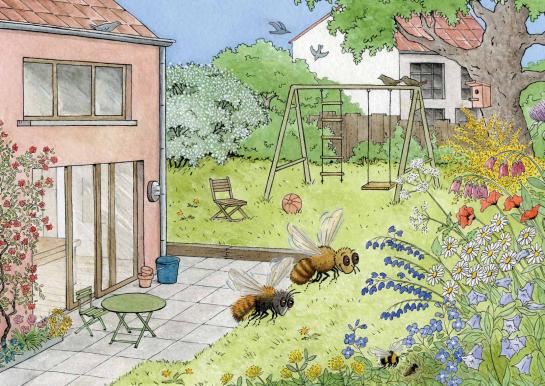
|
TIP!!! Make the link here to your own school garden/playground.
TIP!!! Link to your own school garden/playground. ....
|
|
Picture 8 - Bumblebee comes along 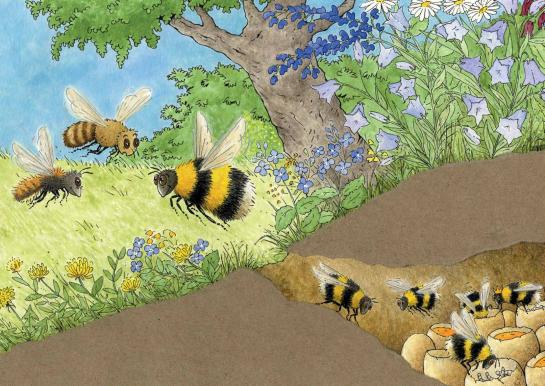
|
|
|
Picture 9 - A bustle at Wasp’s house 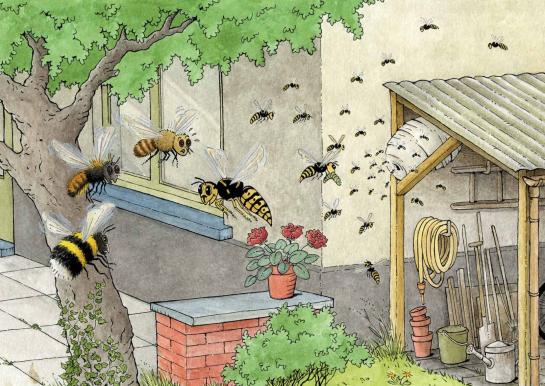
|
|
|
Picture 10 - All sick 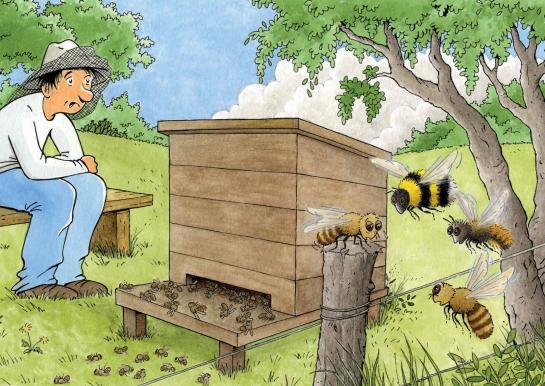
|
|
|
Picture 11 - Night falls 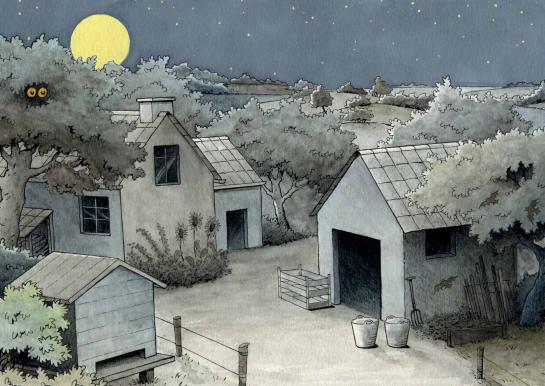
|
Characters
- Bee Gather Honey: picture 1, 2, 3, 5, 6, 7, 8, 9, 10.
- Lony Solitary (wild bee): picture 2, 3, 4, 6, 7, 8, 9, 10.
- Farmer Jeff: picture 10.
- Bumblebee: picture 8, 9, 10.
- Wasp: picture 9.
- Lonely little bee: picture 10.
- Owl: picture 11.
Characters’ feelings
- Picture 1 and 2: Bee is happy.
- Picture 4: Bee is amazed at what Lony does all by herself. Being alone.
- Picture 5: Bee doesn't know what she sees. Togetherness.
- Picture 6: being hungry.
- Picture 8: Bee and Lony are curious.
- Picture 9: Bee is afraid. Wasp is happy. Scare someone.
- Picture 10: Little Bee is sad and feels alone; to be lonely. Beekeeper/farmer Jeff is sad.
Observe in detail
- Picture 1: where are we? How can you tell this is an apple farm? Are there flowers/blossoms on the apple trees? Why is there a ladder against a tree? What animals do you see on and around the farm? Where is Bee's house? Why do you think this is Bee's house? Is it an ordinary house or a closet?
- Picture 2: what is the name of the flower Lony and Bee are sitting on? What are they doing? Which flowers do you still see? → clover. Can you see the difference between their colour and the shape of their petals? Do Lony and Bee look the same? What's different? What is the same? They belong to the same family but look slightly different.
- Picture 3: Which tree does Lony live in? What does that tree look like? What is the difference with the other trees? How could that be?
- Picture 4: how does Lony make a cosy nest in the old tree? What does a woodworm do? What does a bee need to grow?
- Picture 5: what do you see in the beehive? Do you see the part above and the part below?
- What are they doing in the upper part? Would they actually use a cooking pot in real life?
- What happens in the lower part? Do you see the queen? What does the queen do? Do they actually use a spoon in real life? What does a larva eat to grow? How many 'walls' do bee's tiny houses have?
- Picture 6: what do you see/recognize in this garden? What do Lony and Bee mean by 'the food that is getting increasingly scarce'?
- Picture 7: what do you see/recognize in this garden? What animals do you see? How many animals do you see? Can bees find food here? Do you know the name of at least 1 flower? What colours are the flowers? Are there more or less than ten different flowers? How do you know there are children living in the house? What is the name of a bird house?
- Picture 8: where is Bumblebee's house? What (external) differences do you see between Bumblebee, Lony and Bee? What do you see in the surroundings of the nest? → many flowering plants. Do you see the queen? What are the queen and workers doing? Where have you seen that before? → in Bee's closet.
- Picture 9: who is Lony, Bee, and Bumblebee's new friend? Can you name the external differences? Have you ever seen a wasp? Where? (around a sweet drink, ice cream,…). Are you afraid of it? Why? What should you do/not do if a wasp comes close? How can you avoid this?
- Picture 10: what happened to the bees? What made them sick? Where is the lonely little Bee that was left? Does the beekeeper like this? How do you see that? What does the beekeeper have on his head?
- Picture 11: how can you tell it is night? Who or what is in the tree? What noise can you hear on the farm at night? Which nocturnal animals can you still see? How many bats can you count?
Comparative observation
- What differences and similarities about the farm do you see between picture 1 and picture 11?
- What differences and similarities do you see between the appearance of Lony, Bee, Bumblebee and Wasp. For example on pictures 8 and 10.
- For pictures 1, 4, 5, 8, 9: what are the similarities/differences between Lony, Bee, Bumblebee and Wasp’s houses? What differences do you see between the beehive in picture 1 and the one in picture 10?
- What differences do you see between the gardens in picture 6 and picture 7?
- A bee has six legs. In which pictures do you see bees with six legs?
General
apple farm / roll balls / outside world / pass on / village / bustle / take a look / fly in / fly out / family / bright colour / chewed bark / woodworm hole / hide in a corner / land (v.) / clay / delicious things / mouse hole / nest holes / nest / not knowing what you see / scarce / move up a bee / tough / further on / crazy / flight / food.
Insects
pollinate / beehive / growl / beekeeper / insects / queen / larvae / nectar / pollen / buzzing.
Conducting a circle discussion about experiences and feelings in connection with insects
Retelling and portraying a story
Conducting circle discussions about discovering new places and about making friends
Make up a different ending to the story
Conducting a circle discussion about experiences and feelings in connection with insects
- Take, for example, picture 8 or 9 and name the insects.
- Ask if the children have seen them before and what the insects are doing. Let them express experiences, questions and reactions. Let the children respond to each other.
- Tell them what to do if a wasp or bumblebee comes towards you.
- Ask if the children know of any remedies to keep wasps away.
Retelling and portraying a story
- Let the children choose a character: Bee Gather Honey, Lony Solitary, Bumblebee, Wasp, lonely little Bee or farmer Jeff.
- Let them choose between retelling and/or portraying.
- Make the story more interesting together by adding other characters and dialogues: e.g. wife, daughter and/or son of farmer Jeff, another beekeeper,…
Conducting circle discussions about discovering new places and about making friends
- Let children give examples of exploring, setting out together.
- Discuss how they include someone in the group, make new friends, be alone or play together. How do they feel about that?
Make up a different ending to the story
The story ends in sadness: almost all the bees of a hive die. One little bee remains and is taken care of by Bee. Night falls.
- Draw/paint a picture with the children in which Bee arrives at her hive with little bee. All bees are happy. The queen greets the newcomer. They are having a party and preparing a nice corner for the little bee. It gets extra food.
- Have the children imagine what happens on the day after the dark night.
Participate
- Let the children choose which character of the story they want to empathize with.
- Encourage all children to contribute to circle discussions.
- Let children fully fantasize to make the story more interesting and to end it on a happier note.
Observing on the playground and in the school environment
Observing a beehive and honey during a conversation with a beekeeper
Additional activity: watch videos and picture books
Depending on the interest of the class, tell about and clarify facts about bees
Participation by the children and their environment
Compose theme table
- Provide clear pictures of the insects.
- Focus on the bee by means of a few picture books and extra pictures.
- Provide honey and honey products.
- Possibly also add some material from a beekeeper after visiting a beehive.
Observing on the playground and in the school environment
- Are there many flowers? Are there different types of flowers?
- Do you see insects? Do you know what insect it is? Can you find their house? From March to June you have the best chance of seeing the bees at work. Explain to the children that you should not be afraid. Solitary bees do not sting. Honeybees can sting, for example if you irritate them.
- What do bees, bumblebees, but also butterflies and other insects do on a flower?
- Can bees find food here? Where could a flower meadow be sown?
- Do we already have an insect hotel? How does it work? Are there already residents in the hotel? Is it still beautiful or can we improve it, add to it, hang it in a different place, …?
Observing a beehive and honey during a conversation with a beekeeper
- On a trip to a beekeeper. Which flowers and insects do we see along the way?
- Where is the beehive? Can we get close to it?
- What does the beehive look like? On the outside? Inside?
- What does a beekeeper do? What material does he/she have for this? See, among other things, the white suit and headdress of the beekeeper in picture 10.
- What is being done with the honey?
- Check out and taste honey and honey products (sweets, biscuits, drinks,..) and observe beeswax, beeswax cloth,…. This can also be done as a separate observation in the classroom or with the beekeeper in the classroom.
Additional activity: watch videos and picture books
- Find videos of honeybees or solitary bees. Or make your own recording.
- Find a movie about life and work in the beehive.
- You can also find and show recordings of other insects.
Depending on the interest of the class, tell about and clarify facts about bees
- Bees have a body with yellow and black stripes. They have a lot of hair on their body. The body consists of three parts: the head, the chest and the abdomen. They have six legs, five eyes and four wings. Bees smell with their feelers, which are on top of their heads. If the children's interest goes further, you can go into more detail about the difference between bees, bumblebees and other insects. Look for clear photos. Let the children examine the photos and find out what the most common bee species (mason bee, stump bee, ...) and bumblebees look like. You can start from a focused observation of a few pictures.
- Clarify the sentence of picture 3: "We extract a sweet juice 'nectar' from the flowers and process it into tasty honey and in exchange for the nectar we pollinate the flowers so that fruit can grow on the trees." The flowers contain a sweet liquid. It is called nectar and is very deeply hidden. The bees have a long tongue and can reach the nectar. They store it in a second stomach. The flowers also contain pollen. They scrape the pollen together with their front legs and stick it to their hind legs. Then they fly back to the hive. Upon arrival, the bees bring the nectar and pollen to the chambers. They make honey from the nectar. Bees eat honey and pollen. Bees need variety in their food (pollen from multiple types of flowers and plants) to have enough energy.
- Based on pictures 4 and 5 you can illustrate the development from an egg, a larva (look like small worms) to the adult bee.
- The queen of the bees can lay about 2000 eggs a day during the summer.
- Worker bees can work hard: first they learn to clean the chambers, then they feed the queen and the larvae, then they make new six-walled chambers (these are 'cells'). When they are a little older, they guard the entrance to the beehive. They only let in bees from the same family. If they can do all this well, they can fly out to get food.
- The worker bees come out very early in the morning to get food. The older bees tell by means of a dance where the young bees can find the flowers. There are two types of dances: the round dance and the waggle dance. This is how they lure the other bees to them (idea for a motion exercise?).
- Bees get sick because of:
- A spider that attaches itself to the larva and weakens the bee.
- Lack of pollen on a variety of flowers and plants (biodiversity). There is a lot of concrete and asphalt. There are many buildings and gardens have become increasingly neat (see picture 6). There are few (wild) plants and flowers left. Each plant has its own pollen. Bees need pollen from different plants to get enough healthy food.
- The use of poison (pesticides).
- Bees are very important because they provide our food. They pollinate fruits such as cherries, apples, blackberries, raspberries, mangoes and also vegetables such as courgettes, peppers, avocados.
- In winter it is much too cold outside and the bees stay inside. They stop working and huddle close to their queen. They sleep all winter and occasionally snack on the honey. When they hibernate in a beehive, the beekeeper sometimes gives them some sugar water. They wake up when the sun shines again in the spring. Then they go back to work. If it gets really cold, bees can die.
- The beekeeper takes the honey from the hive. He/she then puts on a large white suit, so the bees can't sting. We can eat the honey. Some beekeepers also collect beeswax. We can make candles from this.
- Bees don't just anyhow sting people. If you chase them away, they will come to sting you, or if they smell something sweet on you.
Visual processing
- Drawing bees, following a step-by-step plan.
- Paint/craft bees, beehives and/or flowers?
- After observation, paint a honeycomb with egg cartons. The children can use this during a fantasy play with bee figures.
- Craft a bee hotel.
Participation by the children and their environment
- Work with parents who are willing to welcome the children in their garden.
- Ask the municipality what they can offer and where there are interesting places to visit with children.
- Let the children decide for themselves what they want to investigate.
Taking action with the class and the school
Organize a show moment
- Have the children tell and act out the story for another class group, for (grand)parents. Take the time to practise and prepare the show moment.
- Let the children explain things on the basis of the theme table and the pictures of the story.
- Give the children the opportunity to explain why we should take good care of bees and insects and how we can do that.
- Have the attendees stick a flower as confirmation of their commitment to take good care of flowers and bees.
- Provide honey and some honey products to taste.
- Hand out flower seeds that the children have sorted beforehand.
Taking action with the class and the school
- Find out together which flowers, plants or herbs bees and insects like. Sow or plant or care for some plants. Keep track of the process: does the plant grow well in that location, do insects use it,…?
- Craft bee hotels to hang in different places at school and in the school environment. Check whether bees use it and if necessary find another good place.
- Put up the poster 'a bee-friendly school'. Fill in the checklist and take actions: provide a water dish for bees, a flowering creeper, a container with blooming flowers, make seed bombs with flower seed and some soil, ...
Participate
- Check whether an action together with the municipality, an association, a local company is possible.
- Call on parents for ideas, a place to plant or sow, to help with crafts, …
