

Dory and Cory Pineapple are twin sisters. They are living in Brazil. They know the Apple family who is living here in Belgium. The twin sisters are paying them a visit. Charles Apple is waiting at the airport to pick them up. Dory is there already. She likes travelling by plane. Cory is not there yet. She prefers travelling by ship, in particular, with the pineapple ship. Planes pollute the air a lot. Charles Apple goes, together with Dory and his nephew Bio Apple looking for Cory in the harbour where the boats and ships arrive.
Everyone is happy to see each other again. Dory and Cory are happy because they have been able to settle their fight.
Theme: transport of pineapple by ship or plane, food kilometres
Sub-themes: exotic fruit, (organic) fruit from our region. Organic apples versus sprayed apples, means of transport and their footprints, short and long chain
- You want to clarify that some fruits come from far away and that this is not so good for the earth.
- You want to include exotic fruit in the explanation of the theme "fruit".
- You want to encourage the consumption of healthy fruit. You want to encourage eating apples, pears, ... from here (our region).
- You want to participate in the Week of Taste (mid-November).
- Children are interested in the sea, airplanes, boats, ships, the globe, a world map, transport, harbours, products of other countries….
- Your school takes part in a campaign for healthy, local and seasonal food. You want to strengthen that commitment.
Science and Technology
- Nature: general skills: 1.1 the pre-schoolers can distinguish differences in noise, smell, colour, taste and feeling.
- Nature: General skills: 1.2 The pre-schoolers show an exploratory and experimental approach to learn more about nature.
- Nature: general skills: 1.3 The pre-schoolers can consult sources together with an adult to get to know more about nature.
- Nature: Environment: 1.13 The pre-schoolers show an attitude of care and respect for nature
Man and society
- Man: Me and the other: 1.4 in concrete situations the pre-schoolers can recognize different ways of interacting with each other and talk about it.
- Man: Me and the other: 1.5 the pre-schoolers can recognize in other’s feelings such as being afraid, happy, angry and sad and can empathize with these feelings.
- Man: Me and the other: 1.6 the pre-schoolers know that people can experience the same situation differently and react in a different manner to it
- Society: Socio-Economic Phenomena: 2.1 the pre-schoolers can describe in a simple way adults’ occupations and activities they know.
Languages
- Languages listening: 1.2 The pre-schoolers can understand questions intended for them in concrete situations.
- Languages listening: 1.3 The pre-schoolers can understand an oral message intended for them, supported by images and / or sound.
- Languages listening: 1.5 The pre-schoolers can understand a story listened to, intended for their age group.
- Languages listening: 1.6 The pre-schoolers can demonstrate willingness to listen to each other and to empathize with a message.
- Languages speaking: 2.1 the pre-schoolers can (re)formulate a message and/or story intended for them, in such a way that the content is recognisable.
- Languages speaking: 2.2 the pre-schoolers can talk about experiences or events from their own environment or about what they have heard from others.
- Languages speaking: 2.10 The pre-schoolers can empathize with clearly recognizable roles and situations and respond to them from their own imagination / experience.
|
|

Feel: empathize |
|
|
|

Think: observe and explore: |
|
|
|

Do: work in an organised and active way with the children |
|

|
4.7 'By 2030 ensure all learners acquire knowledge and skills needed to promote sustainable development.' |

|
Ensure sustainable consumption and production patterns. |

|
13.3 'Improving education, awareness and human and institutional capacity on mitigation, adaptation, impact reduction and early warning in connection with climate change'. |
|
Picture 0 – titel + cover 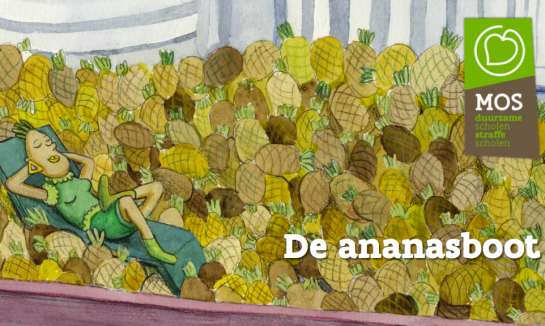
|
|
|
Picture 1 – Charles is waiting for the airplane 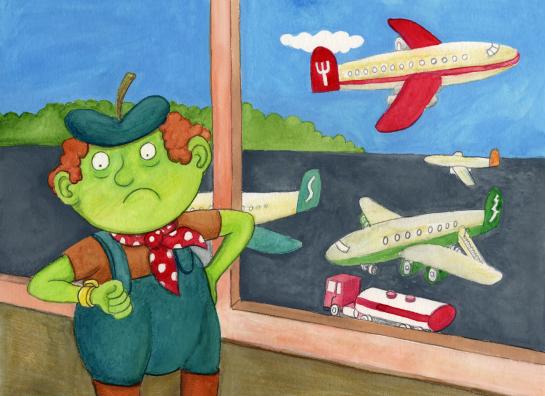
|
Possible key questions for this picture
|
|
|
Possible key questions for this picture
|
|

|
|
|
Picture 4 – Dory and Cory had a fight / angry 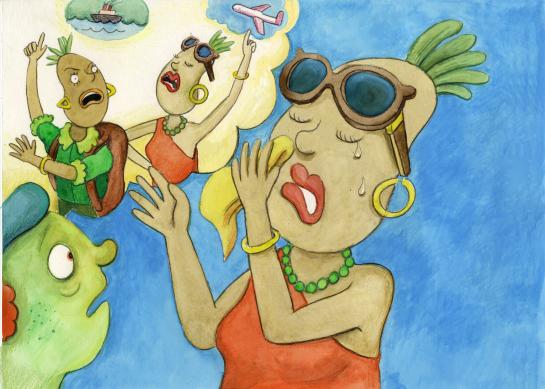
|
Possible key questions for this picture
|
|
Picture 5 – At Bio’s place 
|
Possible key questions for this picture
|
|
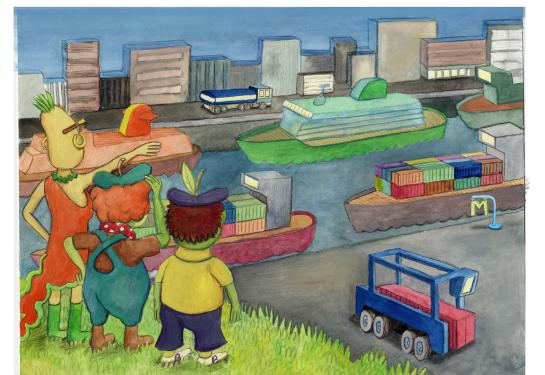
|
|
|
Picture 7 – To the ship from Brazil 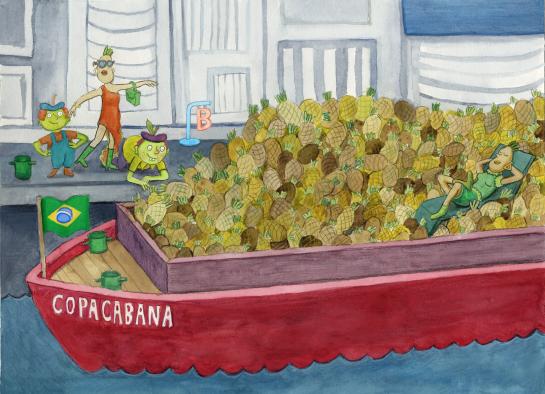
|
Possible key questions for this picture
|
|
Picture 8 - Dory and Cory find each other / happy 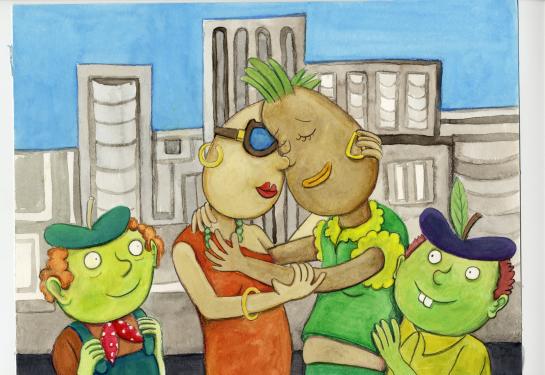
|
|
|
Picture 9 - Cory tells her story 
|
|
|
Picture 10 – Together they leave the harbour 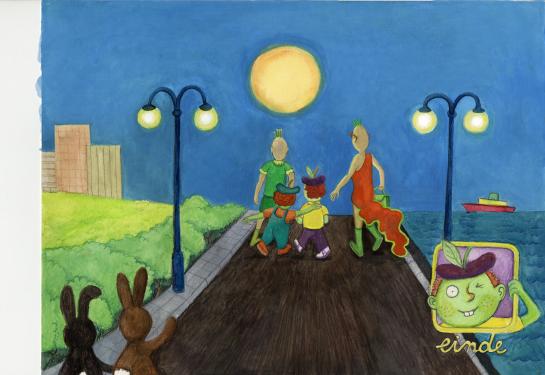
|
Possible actions and challenges
NOTE: Karel Appel really existed! He was a versatile artist who was part of the Cobra group. More information about Karel Appel can be found via Google. |
The characters in the story
- Perception of the shape of the heads.
- Charles Apple: picture 1, 3, 4, 5, 6, 7, 8, 10.
- Dory Pineapple: picture 3, 4, 5, 6, re 7, 8, 10.
- Cory Pineapple: cover, picture 4, 7, 8, 9, 10.
Feelings
- Picture 1: Charles Apple is impatient.
- Picture 4: Dory Pineapple was angry, is sad.
- Picture 6: Dory moans, is afraid that she will not find Cory again. Charles Apple and Dory Pineapple cheer.
- Picture 8: Dory and Cory are very happy to see each other again, they fall happily into each other's arms. They are no longer angry.
- Picture 9: Cory is telling her story enthusiastically, Dory is secretly jealous
- Picture 10: They’re all satisfied together, are laughing
Research tools
- Picture 1: where do planes depart and land? What happens at an airport / aerodrome?
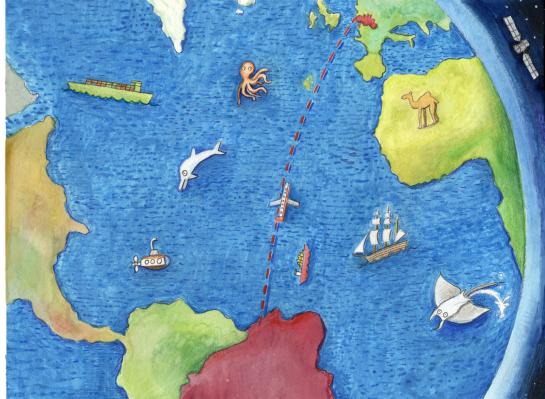
- Picture 2: are you able to find the "great sea" (ocean) and the shape of the countries (continents) as in the picture on a world map / globe?
- Picture 2: what do you see in the "great sea"? Can we find out more about that?
- Picture 6: what does a seaport or harbour with boats and ships look like?
- Picture 7: are pineapples transported on a ship as shown in the picture? Where can we get a box to transport pineapples? Can we observe and examine what is on the box?
Observe in detail
- Picture 1: describe what is typical of Charles Apple’s appearance. What does his head look like? Why can you find trucks at the airport? What do you see on the planes’ tails? Why those letters / characters?
- Picture 2: what do you see in the "great sea"? Which ships or boats do you see? Do you see the pineapple ship? Which animals do you see? What is hanging on the side, next to the earth?
- Picture 3: how do you get off an airplane? What is Dory Pineapple’s' head like?
- Picture 4 and 9: what does Cory have on her back?
- Picture 6: what can you see in a harbour? Why can you find so many trucks in a harbour?
- Picture 9: what was Cory doing on the ship?
- What pictures do you see a letter on?
Comparative observation
- Picture 4 and 8: What similarities and differences do you notice between Dory and Cory Pineapple’s appearances? How to tell they are related? Can you also see that they are twin sisters?
- What differences do you notice between pictures 4 and 8?
- Picture 5: What similarities and differences do you see between Charles’s appearance and Bio Apple’s? What makes you think that Charles Apple and Bio Apple are family?
- Does Charles Apple always wear a wristwatch? In which picture?
- Picture 1 and 6: What is the difference between an airport and a harbour?
mooring / soon / adventures / Belgium / bio / Brazil / the belly of the ship or boat / Cory doesn't think it’s right / movie star / harbour / they talked their heads off / falling into each other's arms / cheering or shouting in unison / jealous / cousin / impatient / advice / race / ripe / boring stuff / moaning / spray / sneaky / tractor / junk / twin sisters / delay.
Empathize with the characters and act out the story with the necessary attributes
Re-enact the story in the gymnasium or outside
Working out and eking out the story and portraying this
Exchange experiences and feelings regarding various aspects of the story
Free play with small materials to re-enact the story
Promote children’s participation
Empathize with the characters and act out the story with the necessary attributes
- Charles Apple: cap with handle / beret, red and white scarf, watch, boots.
- Dory Pineapple: sunglasses, lipstick, round earrings, necklace, bracelet, handbag, bright orange dress.
- Bio Apple: cap with handle / beret, red cheeks, white belt and white shoes with on them the B for Bio.
- Cory Pineapple: triangular earrings, dark green dress, backpack, ...
- Flag of Belgium and flag of Brazil.
- Provide pieces of pineapple and apple during breaks.
Re-enact the story in the gymnasium or outside
This can be done, for example, in the context of a physical activity:
- Stepping over benches like a plane, crossing the hall like a ship.
- Drawing a large world map or delimit land / water.
- Exercises to experience fast and slow.
- Simulate Cory’s and Dory’s body postures
- Provide pieces of pineapple and apple here too.
Working out and eking out the story and portraying this
- Give the characters a mobile phone and let them talk to each other, make arrangements, etc.
- How did the sisters ever get to know Charles Apple? Has Apple's family ever been to Brazil? Do they know each other through the Internet? Have they met before or is this the first time?
- Will the sisters be visiting Charles Apple's orchard and Bio Apple's organic garden or orchard together during their stay here? Do they like pineapple or do they like apples too? Or will they make an apple-pineapple dish together?
Exchange experiences and feelings regarding various aspects of the story
- Exchange of knowledge and opinions, but also experiences, feelings, anecdotes about planes, ships, supply and transport of fruit, advantages and disadvantages of planes, ships,...waiting for an aeroplane, using a clock, far away, close,...
- Whose family has got twins, sisters, brothers, cousins? What experiences and feelings do the children have about them?
- Exchanging dreams, wishes, “what do I want to be when I grow up”: a movie star, a bio farmer,...
- Exchange body postures and feelings: see e.g. Dory’s body postures (she looks like a movie star),...
- Discussing tastes and preferences in connection with eating (exotic and local) fruit.
Free play with small materials to re-enact the story
- Vehicles: aeroplanes, ships and lorries, petrol stations, tankers, containers, pineapples in loose cargo and in boxes or cartons, a grab crane, hoisting crane, scales,....
- Dolls of the characters.
Promote children’s participation
- Let the children decide for themselves how they want to further work out the story.
- Let them also decide what aspects of the story they want to question each other on and find additional information.
- Give the children the opportunity to make suggestions and express preferences for additional activities.
- Decide together with the children about which exotic fruit (kiwi, banana, ....) they want to learn more.
Investigate a shop or a market
Perception / tasting pineapple
Acquire knowledge through info films
Building the long chain and comparing it with the short chain
Discover letters and compare them with the letters in the children's first names
Participation by the children and their immediate environment
Investigate a shop or a market
- Choose a ripe pineapple in the fruit section or in the fruit stand: yellow colour, sweet scent, soft feeling, perception of the transport boxes, packaging, bio, labels, ... How do I know whether the pineapple has come here by ship or by plane?
- Looking for other products connected with pineapple: sliced pineapple in plastic jars, canned pineapple slices, pineapple juice, jam, dried, in yogurt, ice cream, shower gel, ...
- Global observation of other exotic / tropical fruits. What fruit can we still find that comes from far away? Who has already tasted it? Where does it come from? Can we take a picture of the label and look up where the mentioned countries are?
Perception / tasting pineapple
- Compare the appearance and taste of fresh pineapple and canned pineapple, ripe, not ripe yet, too ripe, ...
- Demonstrate how pineapple is cut. Weight before and after cutting, ...
- Explain that a pineapple contains a lot of vitamins and is healthy.
- How do you make a pineapple drink? A pineapple snack?
- How do you eat pineapple? Who has already tasted it? What do you think of the taste?
- How can you limit waste? What do you do with waste?
Processing in images
- In the Caribbean islands, the pineapple is a symbol of friendship and hospitality. That idea spread to us too. As a welcome, you are given a piece of fresh pineapple. You will see pictures of pineapples on doors, tablecloths, napkins, etc.
- Have the shape of the pineapple painted or stamped on paper tablecloths, napkins, etc. You use them to decorate the room, to celebrate together or for a show moment.
Clarify terms
- Local fruit, fruit from here, so-called indigenous or domestic fruit.
- Organic fruit, not sprayed, not treated.
- Short chain and long chain, near and far.
- Seasonal fruit: these are the fruits that traditionally grow in our country in a particular season.
- Exotic or tropical, so-called non-native species.
Acquire knowledge through info films
- Do pineapples also hang on trees like apples do? How does the pineapple grow? How long does a pineapple grow (2 years)?
- Large pineapple plantations require a lot of water. Sometimes that is to the disadvantage of the people who live in the plantation’s vicinity.
- The transport of pineapples. Loading and unloading in Brazil and in Belgium. Transport with trucks to airport or harbours.
- Why eat local and seasonal fruits? Because products imported from distant countries or grown in heated greenhouses cause a lot of pollution and a high energy consumption.
Getting acquainted with the globe / world map, distinction between land and water, continents,… and food kilometres
- Let the children respond to a globe or a world map at the theme table.
- Start from picture 2. Position Belgium and Brazil on the map or on the globe. Discuss how you can travel from here to there and vice versa. Discuss the advantages and disadvantages of the means of transport.
- Look for other countries where pineapples grow. Position them on the world map or globe. Discuss transport and say something too about the energy it takes to travel that far. Discuss the associated emissions and losses, the (food) waste, e.g. concerning transhipment from one means of transport to another.
- Let the children indicate the distance travelled on the world map. Make them feel that flying a lot of kilometres involves high emissions and costs.
- What food is also coming to us from other countries? How can we know that? Where are those countries located? Does that food also come by plane or ship? Or by truck? Does that always go hand in hand with dirty clouds Terra, the earth, does not like?
Building the long chain and comparing it with the short chain
- Clarify, using apples as examples, what is meant by the 'short chain'. The shortest chain is an apple from your own garden! The chain lengthens if you buy apples from the (organic) farmer because you have to cover a distance. The chain becomes even longer if you go and buy apples at the market or in a department store. The apples then travel a longer way past the auction,..
- Use objects and toy transport to depict the whole pineapple’s path in a 'long chain'. Use toy dolls to name the persons who take care of a particular step. Discuss who is involved in the whole process. From plant to mouth: start at a plantation (planting, take care with plenty of water, harvesting after 2 years), gathering at assembly points, transport to a harbour, loading into ship or plane, transporting by ship or plane with storage and refrigeration in transit, arrival at harbour, unloading and storage, transport to warehouses and smaller storage facilities, transport to the auction, transport to large and small shops, display on the shelves, purchase, preparation in the kitchen, tasting and eating.
- Or put pictures of objects, people, means of transport in a long chain of successive steps in order to visualise the long chain.
- Compare a long and a short chain.
- Discuss the advantages and disadvantages of the long and the short chain by reference to pineapples and apples. Feel the disadvantages for people and the planet in the long chain. Let the children feel the benefits of the short chain.
Discover letters and compare them with the letters in the children's first names
- See the perception of the story’s pictures.
- A from Apple, America, advantage...
- B for Bio, Belgium, Brazil, benefit, ...
- Other letters: see the nutrition score (label ABCDE and corresponding colours) on (some) packaging, promotional folders, ...
Free Play with fruit toys
- Offer "exotic fruit" and “local fruit” toys. Also add the dolls of the characters and the means of transport.
- Search for images from store brochures. These images can also be sorted or used for games. Have native fruit placed near a tractor. Have exotic fruit placed next to a plane.
Participation by the children and their immediate environment
- Organize, if achievable, for example, in co-operation with parents, a study visit to a transport location, a harbour, an airport, a place where planes fly over and where children can safely observe them. Visit an auction, a warehouse, a fruit farm,…
- Let the children determine what they want to know or experience about pineapples.
- Let the children choose what other exotic fruits they want to discover and examine.
For those who want more
- Extend to other "exotic" fruits: banana (types, origin, ...), orange, kiwi, (New Zealand, but also Italy).
- Extend to Fair Trade: fair wages for the workers in the plantations so that they are able to live well, have water, children can go to school,... Compare pineapple products from Oxfam World Shops, grapes from South Africa, bananas,….
- Find out how apples were preserved in the past to survive the winter. How are they kept now? Get to know some apple varieties and derived products such as apple juice, apple paste... Early apples already grow in August. The Pink Lady is harvested late, namely at the end of October. This apple variety is cultivated in New Zealand, South Africa and Chile. These apples come to us via a long chain. So they cover a lot of food kilometres!
- Position pineapple in the food triangle, (see “gezondleven.be”.
- Visit an orchard, a place where apples are processed, ...
- Extend to organic vegetables.
- Find information about the many ships that sail the oceans every day. Ships also cause emissions and pollution.
- Tell something about the history of the pineapple. The people of South and Central America had known the pineapple for a long time, when Columbus discovered it in 1493 and brought it with him as a delicacy for the king of Spain. That is why pineapples are also grown in Portugal and Spain.
Organize a show moment for parents, grandparents, other classes
Fortify the action for fruit at school
Participation by the children and the neighbourhood
Organize a show moment for parents, grandparents, other classes
- Design a nice invitation e.g. with a painted or a stamped pineapple. The pineapple is a symbol of hospitality in warm countries!
- Have four children act out the story of the pineapple ship. Give the children the opportunity to tell the further elaborated story.
- Let the children explain that a pineapple is very healthy, rich in vitamins, an exceptional delicacy.
- Help the children show a short and a long chain through some examples. Compare the long chain of the pineapple with the short chain of the apple
- Have the children explain the advantages of the short chain and the disadvantages of the long chain.
- Put larger pieces of apples nearby and make sure that a longer way has to be gone to taste smaller pieces of pineapple. This way, it is made clear that pineapple is something special.
- Or do a 'blind apple test'. Cut up a nice apple and a Pink Lady. Let them taste blindfolded. Which apple do you prefer? Can you describe the taste? Let the children explain that a Pink Lady usually comes from far away by plane. The dirty clouds from an aeroplane are not good for the climate and for the earth.
- Let the children design an action card or poster and give parents the opportunity to support this commitment.
Fortify the action for fruit at school
- See how you can extend and improve the current actions.
- Use a fruit calendar or seasonal calendar to find out about the available fruit. See https://www.velt.nu/fruitkalender or https://www.lekkervanbijons.be/fruit/seizoenskalender-fruit .
- Work together with parents and a fruit grower in the neighbourhood to keep the action going throughout the year.
- Teach children to prevent and processing waste.
Participation by the children and the neighbourhood
- Together with the children, write down an overview of possible actions.
- Work out actions in their order of preference. Let children choose which fruit they want to get to know better and share at school.
